Publications in the field of management sciences |
|
 |
Witczak Hubert, Nauka o zarządzaniu. W kierunku systemu syntezy, 2023, Warszawa: Wydawnictwo CeDeWu, ISBN: 978-83-8102-628-4 The full text of the publication is available: |
 |
Witczak Hubert, Keynes – współczesność – przyszłość [w:] Keynes a współczesność: Ekonomiczne perspektywy dla naszych wnuków, Mączyńska E., Gorynia M., Urbaniec M., (red.), Warszawa: PTE, 2023, s. 201-207. The full text of the publication is available: |
 |
Witczak Hubert, Podsystem dążeń w systemach działających [w:] Współczesne zarządzanie – koncepcje i wyzwania, Sopińska A., Modliński A. (red.), Warszawa: Oficyna Wydawnicza SGH, 2020, s. 119-133. The full text of the publication is available: |
 |
Witczak Hubert, The systemic-praxeological approach to the methodology of primary scientific activity of the management science system, Research Papers in Economics and Finance, 2020, vol. 4, nr 2, s. 7-17. The full text of the publication is available: |
 |
Witczak Hubert, Tożsamość systemu zarządzania publicznego [w:] Nowe zarządzanie publiczne. Aspekty teoretyczne i praktyczne, Pająk K. (red.), Warszawa: Wyd. Naukowe PWN, 2018, s. 183-199. The full text of the publication is available: |
 |
Polowczyk Jan, Witczak Hubert, Błaszak Maciej (red.), Podejście ewolucyjne w naukach społecznych, 2018, Warszawa: Wydawnictwo CeDeWu, ISBN: 978-83-8102-146-3 The full text of the publication is available: This book is a pioneering work on the Polish publishing market, presenting the results of collaboration between researchers from various disciplines within the social sciences. What unites the authors, despite their use of different concepts and cognitive models, is an evolutionary approach rooted in the belief that both individuals and entire societies are the result of long-term developmental processes. These processes follow certain rules. The book is an exceptionally original and useful work. It demonstrates new possibilities for conducting joint research and enriching knowledge in the social sciences as well as the humanities. It may serve as an inspiration for various academic communities in organising interdisciplinary teams. A good example is the development of evolutionary economics as a result of collaboration between economists, psychologists, sociologists and representatives of other disciplines. The book is intended not only for lecturers, but also for PhD students, undergraduates, managers, politicians and anyone interested in new trends in science. [Publisher’s description…] |
|
|
Witczak Hubert, Wprowadzenie do ewolucji systemów działających [w:] Podejście ewolucyjne w naukach społecznych, Polowczyk J., Witczak H., Błaszak M. (red.), Warszawa: CeDeWu, 2018, s. 175-208. The full text of the publication is available: |
 |
Witczak Hubert, Wstęp do naukowego statusu koncepcji zarządzania, Organizacja i Kierowanie, 2014, nr 2, s. 71-85. The full text of the publication is available: The literature presents management concepts (MC) in an unclear manner and on questionable grounds. The problem lies in identifying the very nature and distinctiveness of management concepts against the backdrop of other scientific theories concerning operational systems within which humans exist. Another problem is understanding the status of management concepts in relation to the focus of the management sciences (MS). The aim of this study is to make cognitive progress in this field. I employ a systems approach (research perspective) and hypothetical-deductive reasoning. I use analytical matrices for the purposes of exploring and systematising management concepts. I define the scientific system in terms of operational systems. I define the essence of management concepts and distinguish them from other forms of scientific propositions. I also relate management concepts to the focus of scientific practice and present selected principles for their systematisation. |
 |
Witczak Hubert, Wstęp do systemu nauk o zarządzaniu, Współczesne Zarządzanie: Contemporary Management Quarterly, 2013, nr 2, s. 27-40. The full text of the publication is available: The aim of this paper is to provide an introductory overview of the field of management science. It focuses on selected issues such as the differences between the natural sciences and management science, the systemic nature of management science, and the structure and outcomes of management science. |
|
|
Witczak Hubert, Nauka o zarządzaniu a nauka o ekonomii, Współczesne Zarządzanie: Kwartalnik środowisk naukowych i liderów biznesu, 2007, nr 6, s. 31-42. The full text of the publication is available: Management and economics are inseparable in every action; therefore, they are not independent activities. There is no sphere of human activity that is not subject to management (domain: management) and economics (domain: economics). Management and economics are comprehensive disciplines: they deal with the understanding, evaluation and decision-making regarding any system. Understanding the differences and connections between management and economics has significantly shaped, shapes and will continue to shape the efficiency of social systems. |
 |
Witczak Hubert, Przedsiębiorstwo – system gospodarujący, Zeszyty Naukowe Akademii Ekonomicznej w Poznaniu, 2006, nr 79, s. 31-49. The full text of the publication is available: The author has characterised the enterprise as an economic system. Given the various interpretations of the term ‘system’, the article makes an interesting contribution to the debate on this subject. |
 |
Witczak Hubert, Naukowy status nauki o zarządzaniu [w:] Nowoczesne zarządzanie: koncepcje i instrumenty, M. Trocki, S. Gregorczyk (red.), Warszawa: Szkoła Główna Handlowa. Oficyna Wydawnicza, 2006, s. 13-33. The full text of the publication is available: Governance is the exercise of authority over the reality of human civilisation for the sake of socially beneficial values and goals, though of course we cannot rule out less virtuous ones. In the physical, tangible world, laws operate – it is according to their authority that permanence and repeatability manifest themselves in a macroscopically visible way, often according to rules we do not know or understand. Despite our constant searching, we still lack clarity as to whether nature is ‘managed’ by someone exercising some form of authority, or whether it has always unfolded of its own accord according to ironclad laws that maintain its coherence, organisation and unknown direction. Social systems, unlike natural systems, are artefacts within which people operate, created by a creator who may delegate their authority over them to managers. Owners and managers specialise in exercising and utilising power in relation to these systems. This means that they should behave in accordance with the will and objectives of their creators and managers, which immediately reveals the problem of subjectivity and voluntarism. At first glance, this negates the possibility and feasibility of the operation of laws within social systems and in the management process. Much is expected of science today. In a society of knowledge—and ultimately of wisdom—we hope that the various professional disciplines will dispel the darkness and usher in a new Enlightenment. At the same time, however, we fear ourselves: we are unsure whether the power that knowledge bestows will transform into wisdom, and further into self-knowledge in the realm of values and goals, enabling us to govern reality effectively. In 1961, H. Koontz described the state of management science as the ‘management theory jungle’. The same author, in 1984, was more optimistic and put forward the hypothesis of theoretical convergence. In 2005, the state of management theory is considered to be characterised by greater diversity and opacity than ever before. Does academic activity in the field of management possess characteristics that lend it scientific credibility? Can we speak of a science of management that will help decipher the laws of social systems, whilst at the same time revealing the laws governing them? Must the science of management respect the laws of social systems of which management processes are a constituent part, or can it shape these systems entirely arbitrarily? These are just some of the questions underpinning these considerations. Below, I attempt to answer the question of whether academic activity in the field of social systems management meets the criteria of scientific rigour. In doing so, I seek to define this scientific rigour and justify it. I also address the role and place of management science within the scientific community and the prospects for its development. I believe that the need for such reflection is a continuous and necessary process if we wish to replace faith and hope in the effectiveness of social systems management with evidence, and uncertainty and doubt with the lowest possible risk. [from the Introduction] |
 |
Witczak Hubert, Systematyzacja teorii organizacji i zarządzania, Zeszyty Naukowe Akademii Ekonomicznej w Poznaniu, 2003, nr 33, s. 100-116. The full text of the publication is available: This study is an attempt to reflect on the systematisation of organisational and management theory, but only in terms of reconstructing the current state of affairs. It is more a matter of raising the issue and capturing the existing order than of explaining it. |
 |
Witczak Hubert, Czynniki organizacji, Zeszyty Naukowe Akademii Ekonomicznej w Poznaniu – seria 1, 1981, nr 101, s. 23-39. The full text of the publication is available: The aim of this study is to outline the nature of so-called organisational factors from the perspective of their role in the structure of an organisation. The subject of this discussion is the organisation in general; however, to make the line of reasoning easier to follow, the focus has been narrowed to the socialist industrial enterprise. |
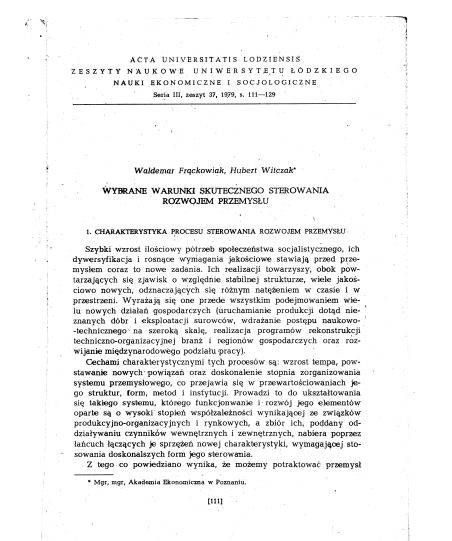 |
Frąckowiak Waldemar, Witczak Hubert, Wybrane warunki skutecznego sterowania rozwojem przemysłu, Acta Universitatis Lodziensis, Zeszyty Naukowe Uniwersytetu Łódzkiego, Nauki Ekonomiczne i Socjologiczne – seria III, 1979, zeszyt 37, s. 111-129. The full text of the publication is available: |
|
|
Frąckowiak W., Skalec L., Witczak H., Kryzys przyspiesza zmiany, Życie Gospodarcze, 1975, R.30, nr 3 (19 stycznia 1975). |