Publications in the field of management science methodology
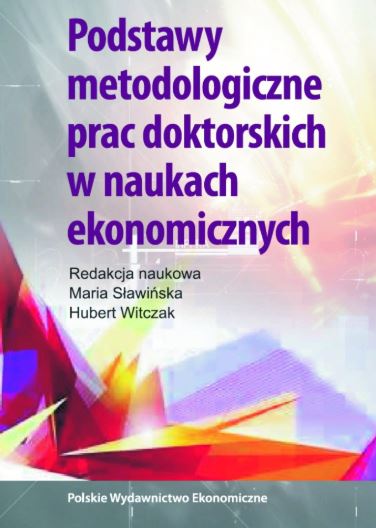
Sławińska Maria, Witczak Hubert (red.), Podstawy metodologiczne prac doktorskich w naukach ekonomicznych, wyd. II, 2012, Warszawa: Polskie Wydawnictwo Ekonomiczne, ISBN: 978-83-208-2028-7.
The growth of doctoral programmes (now referred to as third-cycle programmes) means that it is becoming increasingly important to understand the requirements that a doctoral thesis must meet. The authors therefore outline the following in their book: – economics and management as academic disciplines,
– formulating scientific problems and propositions,
– methods of solving scientific problems,
– the essence of a doctoral thesis in economics,
– the methodology for writing doctoral theses,
– criteria for assessing doctoral theses.
The book is intended for PhD students at universities and economics departments, as well as supervisors of doctoral theses.[Publisher’s description…]
In particular, the following chapters:
– Witczak Hubert, Problemy i twierdzenia naukowe, s. 53-75 [download]
– Witczak Hubert, Twierdzenia naukowe, s. 78-91 [download]
– Witczak Hubert, Systemy twierdzeń naukowych, s. 78-91 [download]
Sławińska Maria, Witczak Hubert (red.), Podstawy metodologiczne prac doktorskich w naukach ekonomicznych, 2008, Warszawa: Polskie Wydawnictwo Ekonomiczne, ISBN: 9788320817607.
The aim of doctoral studies is to prepare doctoral candidates for independent research and creative work, and to enable them to obtain a doctoral degree. Consequently, questions are frequently raised within the academic community regarding the requirements that a doctoral thesis in the field of economics must meet. The authors of Methodological Foundations of Doctoral Theses in Economics have presented, in a systematic manner, the fundamental issues concerning the methodology of doctoral theses, and in particular: the links between economics and management sciences; scientific problems, hypotheses and theorems; and techniques of the scientific process; selected methods for solving scientific problems; the methodology of writing doctoral theses; and the criteria for their assessment. [Publisher’s description…]
Witczak Hubert, U podstaw twierdzeń nauki o zarządzaniu [w:] Podstawy metodologiczne prac doktorskich w naukach ekonomicznych, Sławińska M., (red.), 2006, Poznań: Wydawnictwo Akademii Ekonomicznej w Poznaniu, s. 135-151.
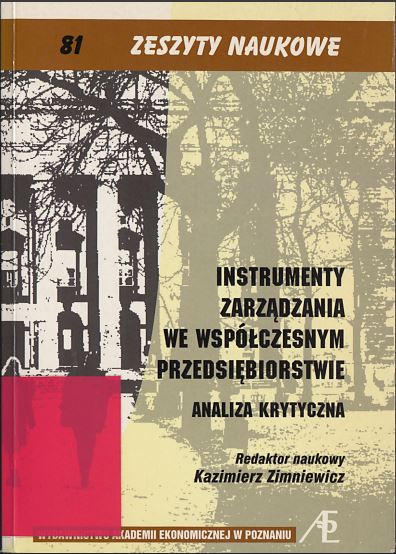
Witczak Hubert, Problem naukowy jako podstawa aktywności naukowej w nauce o zarządzaniu, Zeszyty Naukowe Akademii Ekonomicznej w Poznaniu, 2006, nr 81, s. 605-615.
This article outlines the systemic characteristics of scientific rigour. It discusses the purpose of scientific activity, the requirements for scientific rigour, the scientific system and process, and the fundamental operations of science. It then examines the scientific nature of problems in management science, presents the characteristics of a scientific problem, and briefly describes the process of identifying scientific problems.
Witczak Hubert, Teoretyczno-metodologiczne podstawy zarządzania ochroną środowiska [w:] Problemy organizacji i zarządzania ochroną środowiska w Polsce, Zimniewicz K., (red.), 1990, Warszawa-Poznań: PWN.
Humans and human societies are relatively isolated systems, which means that they exist within a specific environment and depend on that environment. This perspective highlights the overwhelming influence of the environment on humans, but it also draws attention to the feedback loops involved. Whilst the environment constitutes a universe for humans, given a certain extent and passivity in mutual relations, a situation may arise in which human activity disrupts, or even destroys, its own environment. Today, as a result of resource depletion and the recklessness of rapid civilisational acceleration, this deconstruction has reached a local level, yet on a planetary scale. The issue of environmental management has not yet been the subject of theoretical and methodological reflection. Addressing it has significant value, primarily practical, as management is a fundamental factor in the implementation of conservation models and a prerequisite for their effectiveness. In this context, the discussion centres on the theoretical and methodological foundations of environmental protection management, in particular the positioning of environmental protection within the structure of human activities, defining the essence of environmental protection management, and addressing the issue of models and methods of environmental protection management viewed through the lens of organisational and management theory and systems theory.