Witczak Hubert, Strategiczne uwarunkowania systemu edukacji uczelni wyższej płynące ze sfery zarządzania [w:] Dążenie do doskonałości w edukacji wyższej w naukach społecznych, Mruk H., Orliński R., (red.), 2020, Poznań: WSZiB Poznań, PTE Oddział w Poznaniu, Seria „Studia Ekonomiczne”, ISBN 978-83-958472-5-7, s. 147–163.
The university education system can be said to be run successfully if it achieves its economic, non-economic and security objectives. Such success is impossible without a professional approach to education, that is understanding, and then applying, the theo- retical and practical foundations of its system naturę and the strategie determinants shap- ing it. These determinants constitute a non-simple sum of external and internal stimuli (some of them rooted in the sphere of management), which together create the situa- tion and context. The stimuli prompt university entities to shape the structure, function, behaviour and activities of the education system in a specific way. In Poland AD 2019, in the short-term strategie perspective, university education systems will be prompted to treat education primarily as a means of economic survival for the institutions.
Witczak Hubert, Wprowadzenie do związku między wybranymi prawami nauk a skutecznością zarządzania strategicznego, Management Forum, 2018, vol. 6, nr 1, s. 40-53.
The aim of this study is to provide a better understanding, compared to the current state of research, of the relationship between selected scientific laws and the effectiveness of strategic management (SM) of operational systems (OS). Incomplete effectiveness is a permanent feature, despite the systemic nature of SM. The material scope of the study covers selected scientific laws as they relate to OS as a category. The subject scope concerns the potential influence of selected scientific laws on the strategic effectiveness of OS within a universal space-time (ST). A systemic-praxeological approach was applied, utilising a diagnostic-prognostic method and hypothetical-deductive reasoning. In addition to the preliminary identification of the potential for such relationships, the essence of the work is the assertion of the limited effectiveness of SM. Among the laws discussed, the following play a key role in the effectiveness of SD: the law of economic surplus; the law of necessary diversity; and the laws of the limitations of cognition. The general conclusions suggest a perspective of strategic effectiveness. In addition to the need to respect these laws within SD, it is essential to make continuous efforts to reduce the imperfections in their application.
Witczak Hubert, Wstępne rozpoznanie istoty potencjału strategicznego systemu działającego, Management Forum, 2017, vol. 5, nr 3, s. 45-51.
In management studies, there is a need for a better understanding of the category of ‘strategic potential’. The aim of this paper is to propose preliminary propositions regarding the identification and exploration of this concept. The scope of this paper covers the strategic potential of any operating system (OS). Strategic potential is the ability of a given AS to shape strategic changes in order to achieve strategic success. Strategic potential is a complex sum of intricate variables: the strategic domain, as well as the flexibility, uniqueness, competence, efficiency, attractiveness and controllability of a given AS. It is a key determinant of strategic success. The scale of strategic potential ranges from its absence (level zero potential) to its full extent (level 1 potential). Strategic potential requires further research, including classification and explanatory studies.
Witczak Hubert, System innowacji [w:] Zarządzanie przedsiębiorstwem inteligentnym. Wybrane zagadnienia, Grzegorczyk S., Mierzejewska W., (red.), 2016, Warszawa: Oficyna Wydawnicza SGH w Warszawie, s. 431-446.
– Google Scholar
The aim of this work is to identify the category of the “innovation system” and its role in the success of the “action system”. It is done by combining the systematic and praxeological approaches, based on the hypothetico-deductive method. The innovation system may be a separate type of the action system (AS) when its main and exclusive purpose it to generate specific innovations. It may also be developed within the framework of other ASs to serve their strategic values and goals. The innovation system includes interconnected: 1) innovation aspirations; 2) core of innovation activity; 3) innovation doctrine; 4) innovation situation; 5) constraints on innovation. The innovation potential of an AS is a non-simple sum of its innovation state and innovation readiness. Shaping the innovation potential is invariably a necessary factor in the strategic success of ASs.
Witczak Hubert, Doktryny zarządzania strategicznego, Prace Naukowe Uniwersytetu Ekonomicznego we Wrocławiu, 2016, nr 420, s. 398-410.
The question at the heart of this article is: ‘What principles should guide strategic management?’. It is by no means obvious that a strategist can (should, must, etc.) pursue a strategy solely by adapting to the situation or striving for values, objectives, etc. The doctrines of strategic management of functioning systems were examined, at a categorical level, using a systems approach and a hypothetical-deductive method of reasoning. The problem and cognitive aim of this work is an attempt to determine the role of a priori assumptions (doctrines) of strategic management for strategic efficiency and success. There are almost always certain a priori assumptions of strategic management. The strategist selects a more or less specific set of doctrinal propositions according to which he or she conducts the strategy. The potential of the doctrine is determined on the basis of many sources, and its rational propositions are only part of the set of doctrinal propositions. The role of strategic management doctrine cannot be overestimated from the point of view of strategic effectiveness and success.
Witczak Hubert, Elementy aksjologiczne kontekstu sukcesu strategicznego, Prace i Materiały Wydziału Zarządzania Uniwersytetu Gdańskiego, 2011, nr 4/3, s. 231-243.
The aim of this article is to identify selected components of the axiological context of strategic success. The principles by which we assess and evaluate an operating system and its management system influence the values that an entity recognises and shapes. The evaluation of strategic success is, like strategy itself, a situational game—specifically, an inter-entity one. These games, and their outcomes, are neither the exclusive domain of a single entity nor entirely rational and reflective. The evaluation of success is a function of the internal structure of the entity itself or its governing body, as well as the degree of egocentrism adopted in external relations. Consequently, it is necessary to conduct a kind of axiological assessment of strategic success.
Witczak Hubert, Próba wzbogacenia kluczowych pojęć istotnych dla zarządzania strategicznego, Zeszyty Naukowe Uniwersytetu Ekonomicznego w Poznaniu, 2009, nr 129, s. 630-636.
The idea behind this paper is based on the conviction that concepts possess significant instrumental value. The multifaceted and eclectic nature of management studies, including strategic management, calls for a return to first principles, including concepts. Reaching a consensus on these concepts forms the foundation of academic discourse and management practice. The author of the article examines the relationships between concepts important for strategic management, arguing that strategy is: 1) not merely strategic management and 2) not merely a strategic plan. (fragment of text).
Witczak Hubert, Otwarcie MŚP a integracja nadsystemu : próba definiowania pola naukowego, Prace Naukowe Uniwersytetu Ekonomicznego we Wrocławiu, 2009, nr 49, s. 108-115.
The subject of this study was SMEs, i.e. sole traders, micro-enterprises and small enterprises, regardless of their legal or economic status or classification, established independently by individuals seeking to become entrepreneurs. They will either become a permanent component of the socio-economic supersystem (the mature phase) or disappear (the non-existence phase) after leaving the inter-phase transition in the real sphere. Remaining in the inter-phase transition is inherently disadvantageous; therefore, the aim is to exit it as efficiently as possible. Entering the maturity phase guarantees a higher probability of longevity, which also benefits the supersystem. Conversely, disappearance reduces the costs of the would-be entrepreneur and makes the energy of the prospective SME available to other entities. The author has attempted to define a field of study concerning the relationship between the level of supersystem integration and the efficiency with which an SME exits the interphase transition. The author employed a systems approach and a metalanguage, as well as a prognostic method utilising deductive reasoning.
Witczak Hubert, Zarządzanie zmianą – zmiana zarządzania, Zeszyty Naukowe Akademii Ekonomicznej w Poznaniu, 2008, nr 105, s. 99-121.
The aim of this study is to examine the nature of ‘change management’ in social systems, particularly in the context of business, from both a cognitive and a normative perspective.
Witczak Hubert, Strategiczny sukces przedsiębiorstwa, Prace i Materiały Wydziału Zarządzania Uniwersytetu Gdańskiego, 2007, nr 2, s. 262-275.
This paper provides an overview of existing concepts of strategic business success found in the available literature. Against this backdrop, an attempt is made to define the essence of this category of success and to identify the requirements that an entrepreneur must meet in order to achieve success in the near future. The aim is to identify the essence of strategic success, based on such categorical concepts as enterprise, strategy and success, and to define its concept and future determinants through deductive and cognitive reasoning.
Urbanowska-Sojkin Elżbieta, Banaszyk Piotr, Witczak Hubert, Zarządzanie strategiczne przedsiębiorstwem, 2007, Warszawa: Polskie Wydawnictwo Ekonomiczne, ISBN: 9788321017102
This book is a comprehensive study that thoroughly systematises knowledge in the field of strategic business management. The authors provide an exhaustive explanation of the essence and scope of this management. They examine the successive phases of the strategic business management process in an innovative way. They present an analysis and critical assessment of strategic conditions, the issues of formulating objectives and the strategic direction of the company’s development, the question of strategy implementation, and the supervision and control (controlling) of its execution. [Publisher’s description…]
Witczak Hubert, Podstawowe problemy zarządzania strategicznego przedsiębiorstwem, Zeszyty Naukowe Akademii Ekonomicznej w Poznaniu, 2007, nr 86, s. 156-166.
This article outlines the roles performed by an entrepreneur, namely the creation and management of a business. It describes the challenges associated with running a business and possible strategic responses. It also provides a general overview of the issue of strategic business management.
Urbanowska-Sojkin Elżbieta, Banaszyk Piotr, Witczak Hubert, Zarządzanie strategiczne przedsiębiorstwem, 2004, Warszawa: Polskie Wydawnictwo Ekonomiczne, ISBN: 8321014960.
The full text of the publication is available:
– ResearchGate
Witczak Hubert, Implementacja w zarządzaniu strategicznym, Zeszyty Naukowe Akademii Ekonomicznej w Poznaniu, 2004, nr 43, s. 85-107.
This article examines the nature of implementation and its role as a key phase of strategic management. It reviews various approaches to strategy implementation and sets out the principles governing the role of implementation in strategic management.
Witczak Hubert, Przedmiot zarządzania strategicznego [w:] Zarządzanie strategiczne przedsiębiorstwem, Urbanowska-Sojkin E., Banaszyk P., Witczak H., (red.), 2004, Warszawa: Polskie Wydawnictwo Ekonomiczne, s. 9-36.
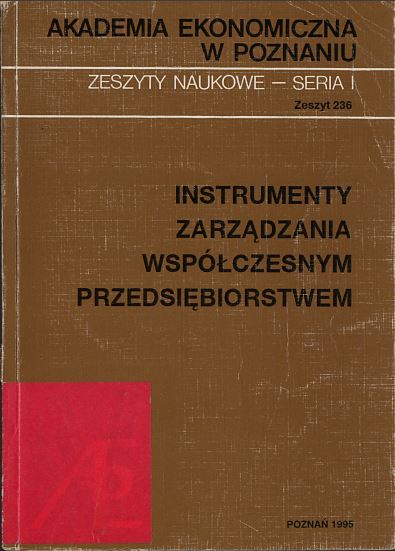
Witczak Hubert, Metodyka podstaw formułowania strategii przedsiębiorstwa, Zeszyty Naukowe Akademii Ekonomicznej w Poznaniu – seria 1, 1995, nr 236, s. 73-88.
The purpose of this article is to present professional approaches to formulating corporate strategy, taking into account the strategic management cycle and its components. It discusses the strategic management cycle, the logic behind strategy formulation, the company’s mission, vision and long-term objectives, as well as strategic issues and strategic diagnosis, providing a classification of the methods and techniques involved.
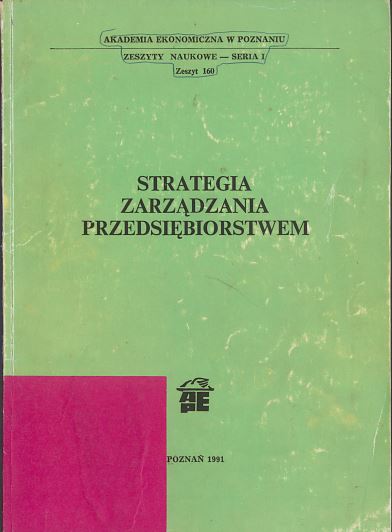
Witczak Hubert, Strategiczne uzależnienia działalności przedsiębiorstw, Zeszyty Naukowe Akademii Ekonomicznej w Poznaniu – seria 1, 1991, nr 160, s. 69-82.
An enterprise is a specific form of organisation of human activity. The fundamental attributes of an enterprise are: – the pursuit of any socially acceptable activity – consisting of the provision of products and services to the community, – the management of any resources, – acting on behalf of, in the interests of, and for the account of the owner(s), – economic surplus, derived from the business activities, as the main motive and condition for the enterprise’s existence and development. The social justification for the existence and development of an enterprise must lie in its outputs, that is, its products and services, which are socially accepted through the act of purchase and sale. This acceptance may be voluntary, through a free choice made by the customer, or forced, for example under monopoly conditions. If an enterprise fails to gain market acceptance for its products and services, it loses its social raison d’être. Under certain conditions, for example in the absence of other sources of financial support (credit, etc.), a failure to gain acceptance hinders or prevents the generation of an economic surplus from the business’s operations.
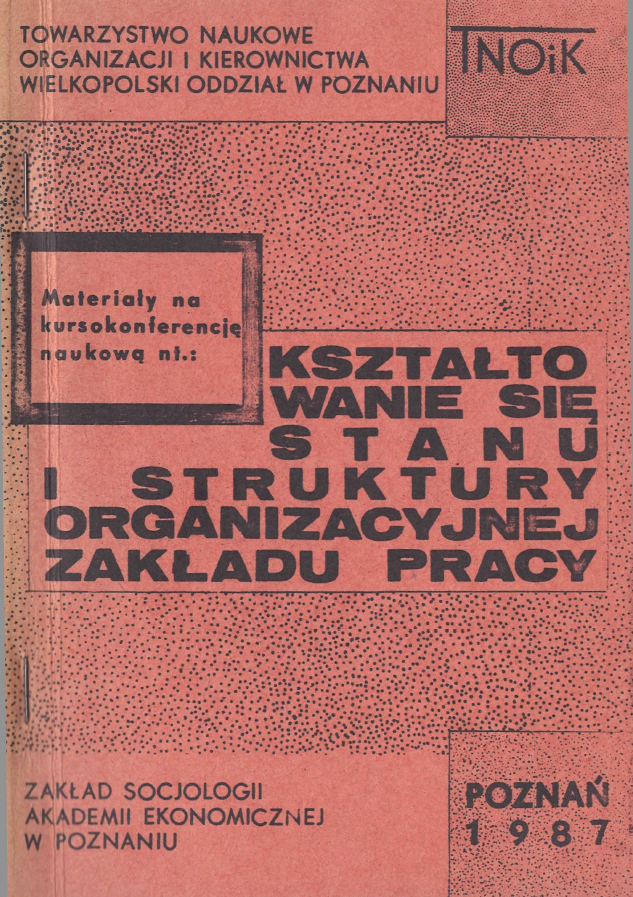
Witczak Hubert, Strukturalne uwarunkowania zachowań podmiotów gospodarczych i ich skutki [w:] Kształtowanie się stanu i struktury organizacyjnej zakładu pracy, Januszek H., (red.), 1987, Poznań: TNOiK Poznań i in., s.5-14.
The full text of the publication is available:
– ResearchGate
A structure is an arrangement of elements and the relationships between them, specific to any object, process or phenomenon. The organisational structure of a workplace is therefore a class or type of structure distinguished by the object (the workplace or enterprise) and the characteristic of ‘organisation’. We generally define a structure by specifying its ‘elements’ and ‘relationships’ in more detail. The concept of organisational structure is ambiguous. Without discussing it further, we assume that:
a/ statically speaking, it is the arrangement of job positions within organisational units (elements) linked by bonds of mutual contribution (relationships) to the success of the whole (here: the enterprise).
b/ dynamically speaking, it is the arrangement of activities /elements/ linked by bonds of mutual contribution /relationships/ to the success of the whole /here: the enterprise/.
In both cases, the characteristic of ‘organisationality’ is ensured by bonds of cooperation, i.e. positive relationships – in view of the enterprise’s main objectives and conditions – between its components (linear, supply, stimulation and functional bonds).
The phrase “the formation” of the state and organisational structure of a workplace suggests that these depend both on consciously undertaken “shaping” processes and on unspecified random factors or a combination of circumstances that cannot be subject to rational and direct control. On the other hand, the ‘shaping’ of the state and structure has a reciprocal effect on the aforementioned factors, because all human activity, including that of entrepreneurs, must be organised in a specific way, which has socio-economic, psychological and other consequences. I intend to demonstrate below that, in our country, a certain fundamental structural mechanism is currently responsible for the nature of the interaction between the state and organisational structure of industrial enterprises and other factors. This mechanism leads to the state and structure being a derivative of the enterprise’s strategy, which in turn depends on the state and structure primarily of the external environment but also of the company’s internal environment. For the sake of clarity, let us recall that by ‘strategy’ we mean responding to changes in the environment, including in particular other entities.
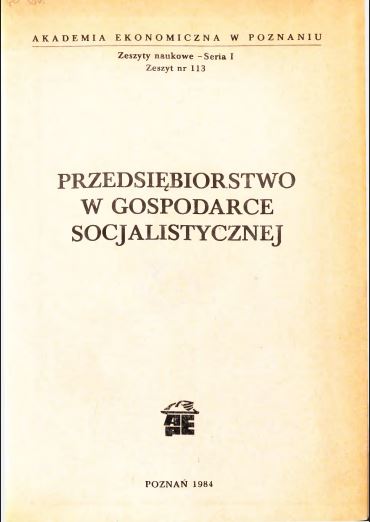
Witczak Hubert, Organizacyjne uwarunkowania strategii przedsiębiorstwa wobec otoczenia, Zeszyty Naukowe Akademii Ekonomicznej w Poznaniu – seria 1, 1984, nr 113, s. 40-60.
The aim of this study is to demonstrate that the strategy of a socialist industrial enterprise and its outcomes depend significantly on its organisational links with the external environment. Here, we understand strategy as a framework programme of the system’s (the enterprise’s) fundamental responses to changes in the external environment. In this context, strategy: primarily comprises objectives, criteria and principles of conduct formulated as key decisions – ‘responses’ to changes in the environment; is the result of a specific interaction with the environment; and is a fundamental programme from which tactical and operational plans are derived. The enterprise’s environment – apart from the physical one – is always dynamic and, to a greater or lesser extent, ordered and organised, regardless of whether this degree of order is caused by the enterprise itself, an external organiser, or self-organising processes (e.g. the market). This order is also characterised by a certain degree of stability (or volatility). If we consider social reality as such, the enterprise is also situated ‘within’ this order, and is therefore subject to organisational constraints external to itself. This has significant consequences for enterprise-environment feedback loops and their effects.